

Running
MCP
GuideFlow3D
🤗
A HF Space that demonstrates all use-cases for GuideFlow3D
3D Computer Vision, Semantic Understanding, SLAM, Multi-modal Interactions, Spatiotemporal Reasoning, VLMs/LLMs

GuideFlow3D: Optimization-Guided Rectified Flow For Appearance Transfer
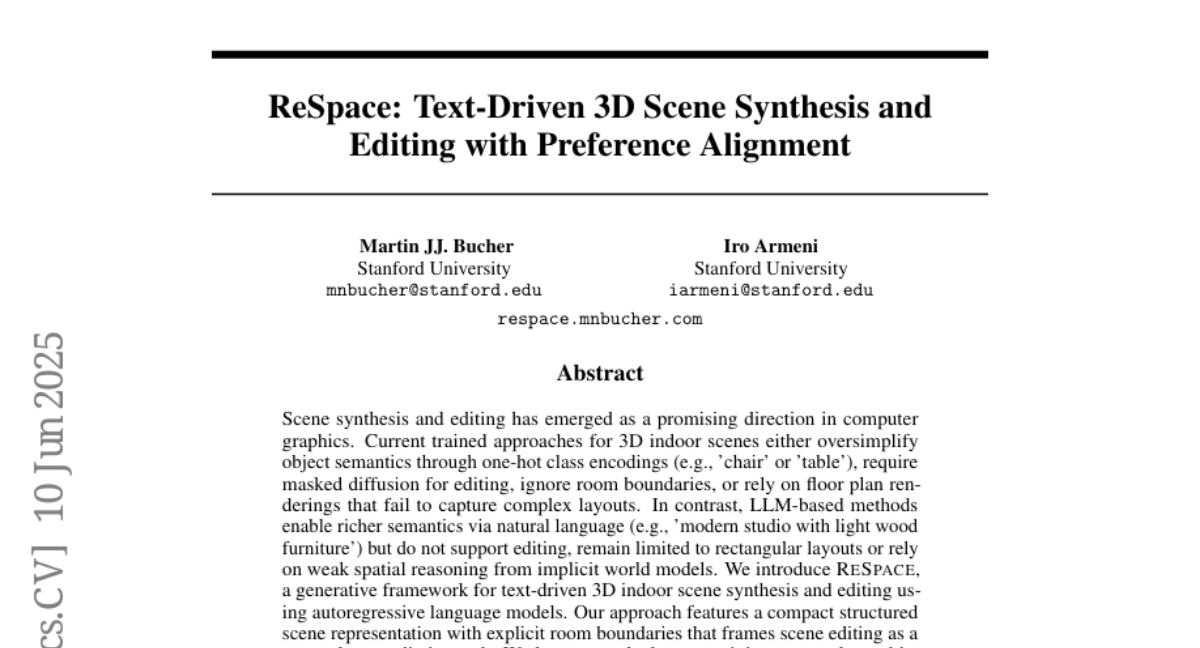
ReSpace: Text-Driven 3D Scene Synthesis and Editing with Preference Alignment

Gradient Spaces is a research group in the Civil and Environmental Engineering Department, Stanford University, under the Schools of Engineering and Sustainability. Our research and educational activities focus on developing quantitative and data-driven methods that learn from real-world visual data to design and construct data-driven sustainable and adaptive environments across the physical and digital space. Of particular interest is the creation of spaces that blend from the 100% physical (real reality) to the 100% digital (virtual reality) and anything in between, with the use of mixed reality and multi-level design (i.e., of buildings, processes, UXs, etc.). We believe that by cross-pollinating the two domains, we can achieve higher immersion and view these spaces as a step toward more equitable living conditions. Hence, we aim for developing methods that work in real-world settings on a global scale. To achieve the above, we are building a cross- and inter- disciplinary team that is diverse and well-rounded. Most importantly, we are driven by curiosity and learning, and so does everything we do.
Check out all our research work and who we are here: https://gradientspaces.stanford.edu